
The Woolf Looks into the Forest
What do Hanukkah, Sydney and baggage claim have in common?

My father was shaving. I was standing in the hallway. He looked out from the bathroom, razor in hand, foam on his face, and said: By the way, you’re Jewish. Then he continued to shave.
Kyiv. Late 1980s. I was nine years old. I had never heard this word before. Where am I Jewish? What part of me? I didn’t ask. He didn’t explain. The moment passed like a small strange bird through an open window. I am still trying to understand where it landed.
Years later I made a play about immigrants. I wanted a real baggage carousel on stage—the kind you stand around at airports, watching suitcases circle and circle. Everyone said it was impossible. We found one in Rhode Island and hauled it up to the second floor of our theater in Needham, MA. Because this is where we live, I explained. We left but we never arrived. We are here, in America, but we are still standing at the baggage claim. Waiting for our valuables. And some of them never come.
This is what it means to be an immigrant. This in-between. This unsettled soul between worlds. Dybbuks.
I sold cell phones at Singular Wireless. I knocked on doors with yellow page advertisements—you carry a bag and travel from business to business. Then mortgages. I passed my exam, became a broker. I was earning. I was surviving.
But inside? A hunger that had no name.
My friend Misha, who worked with me at Mass Capital Mortgage, once told me a Russian proverb: No matter how much you feed the wolf, he always looks into the forest.
We were sitting in the office, surrounded by loan applications and interest rates. No amount of commission checks could stop me from turning my head toward those dark trees.
So I emailed every artistic director in Boston. Every single one.
Zero response.
My grandfather’s name was Fleishman. In the Soviet Union, it became Golyak. Less Jewish. Safer. This is what we learn: to scrub ourselves. To make the edges softer. To tiptoe through rooms as if the floor might break.
We left Kyiv when I was eleven. We left because of antisemitism—the thing that followed our people for centuries, the thing we thought we could outrun. Vienna, then Rome, then Boston. Waiting at each station for permission to exist.
And in America? I emailed. I waited. I had already learned to shrink.
The immigrant does not know the invisible rules. We don’t know that you call again. That you nag. We don’t know that you invite people for coffee. We stand at the edge of rooms, watching, and the watching becomes a kind of hiding. We wait for permission that was never ours to receive.
I am in New York this week. Hanukkah begins tonight.
And this morning, in Sydney, on Bondi Beach, gunmen opened fire on a Hanukkah celebration. Sixteen dead. A twelve-year-old girl. A rabbi. More than a thousand people had gathered to light the first candle, and instead there was slaughter.
On the first day of Hanukkah.
The Festival of Lights.
This is not new. This is the oldest story. We fled Kyiv because of this. We fled Poland before that. We fled Spain, Germany, Russia, everywhere. The hatred follows. It waits. It finds us at the beach, at the synagogue, at the celebration.
And still we light candles.
I am thinking about the Tenement Museum on the Lower East Side. Twenty-one identical apartments, three hundred twenty-five square feet each. The largest family they ever documented living in one? Sixteen people.
No running water until 1912. Outhouses in the backyard. In New York City. In the twentieth century.
Jewish immigrants. Fleeing. Arriving. Building. Persisting.
You walk through those rooms and you understand: we have always been fleeing. And we have always been building anyway.
The same hands that packed suitcases in the night also opened shops in the morning. The same people who ran from pogroms also raised children who raised children who raised me.
This is the inheritance. Flight and persistence. Both. Always both.
Something is shifting for me now.
For years, I sent emails into the void. For years, I learned that the doors were not for me.
And now—I don’t fully understand it—there are people saying yes. People at the Met Opera signing up for this blog. People traveling to see the work I make for my new home.
A friend once told me about his mentor, a man named Ron. He asked Ron: why did you take that first meeting with me all those years ago? Was I persuasive on the phone? And Ron said: No. My mother taught me when I was a kid—if somebody asks for your help, you help them. So I meet with everyone who calls me.
But you only get a second meeting if I think you’re really good. Everybody gets a free first meeting. You got the second meeting. That’s the important part.
If somebody asks for your help, you help them.
I think about all the emails I sent that went unanswered. I think about the years of silence. And I think about the people now—these extraordinary, beautiful people—who are saying yes. Who are lighting candles in the darkness. Who are, in their own way, keeping the oil burning longer than it should.
This is the miracle of Hanukkah. Not that the darkness ends. The darkness does not end—it is happening right now, in Sydney, in a thousand places we cannot name.
The miracle is that the light persists anyway.
One day of oil. Eight days of flame.
Theater, for me, is about widening. That’s all it does. It tries to widen the perspective so that there is a chance—just a chance—of not getting stuck within a certain mindset. So that maybe, possibly, the attack that is always developing can be seen before it arrives.
Not by preaching. By widening. By showing how good people can do unbelievably horrible things and also something beautiful and unexpected. Both. By showing that the hatred is not somewhere far away in some distant past. It is here. It is in us. It is in the people who play soccer together and sing together and then burn each other.
When we staged Witness—our play about Jewish refugees turned away from America—a gunman was holding a rabbi hostage in Colleyville, Texas. We incorporated the live news feed into the performance.
When we were preparing Our Class—our play about Polish classmates who become murderers—October 7th happened.
And now Sydney. On the first night of Hanukkah.
The work keeps finding the darkness. Or the darkness keeps finding the work. I don’t know which.
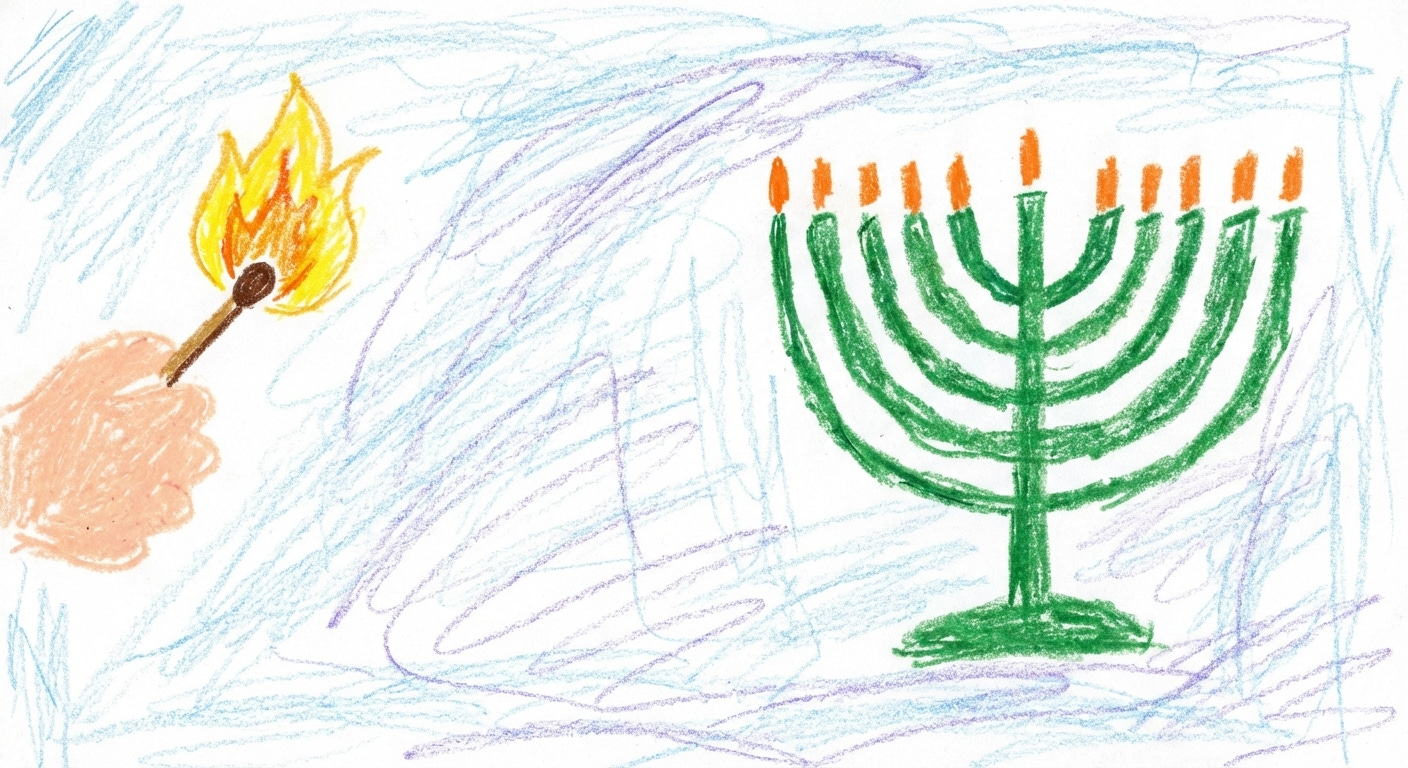
Tonight the first candle will be lit. Tomorrow two. And so on, until eight flames push back against the December darkness.
Sixteen people will not light candles tonight. A twelve-year-old girl will not grow up. A rabbi will not bless another congregation.
And still we light candles.
Because this is what we do. This is what we have always done. In the shtetls before the pogroms. In the tenements of the Lower East Side. In Sydney tomorrow night, I am certain, despite everything.
Someone will strike a match.
For an immigrant, to be here—really here, contributing, mattering—still feels like a miracle. Oil that should not have lasted. Light that should not have persisted.
But it does. We do.
To the people in New York who are opening doors. To the people who say yes when the world says no. To the people who take the meeting and offer the second one. To everyone who lights a candle knowing that the darkness has not ended and may never end.
Thank you.
And to those in Sydney. To the sixteen. May your memory be a blessing.
Happy Hanukkah.
— Igor
“For thou wilt light my candle…” “Lighten our darkness we beseech thee o Lord.”
we will never stop lighting candles.
happy hanukkah, igor, to you and yours.