
The Script Is Not Sacred. Your Audience Is.
Every director who treats the script as sacred is staging a corpse.

The production was correct. The lights hit their marks, the doors opened on cue, the actors stood where the page told them to stand and said every line in the order the lines were written. When it ended the audience applauded, the even applause of people who got exactly what they expected, and reached for their coats. Nobody in that room walked out different than they walked in.
I have sat in that dark and learned to read that applause. A thing that is arranged correctly and a thing that is alive are not the same thing, and the body knows the difference before the mind can argue with it. What I am watching is a corpse. Not a play. A corpse. A body that was alive once, inside the emergency of another person, inside the year of another person, carried into the rehearsal room and propped up in a chair and dressed in the right clothes and asked to speak.
And it does speak. It does everything you ask. It just will not breathe.
I want to be fair to the director who built it, because I have been that director, and the instinct is honorable. You were trained to open the text, find the stage directions, honor the playwright, execute what is on the page as faithfully as you can. The page is what you were handed. The page is what the critics check you against. You want to serve the writer, to be the honest vessel through which a great mind reaches the audience. Nobody wants to be the vain director who smears his own fingerprints across a masterpiece.
So you make yourself small. You follow the directions, you honor the pauses, you handle the script like a relic under museum glass. You call this respect.
It is not respect. It is a burial with good manners.
Consider the play I have been living inside for months. Ionesco wrote Delire a deux, frenzy for two, on a commission that specified almost nothing. A bed in the middle, two doors on the sides, a couple that fights. That is the whole brief. A man and a woman argue about whether a snail and a turtle are the same animal. They insult each other, they contradict each other, one of them says the telephone is a cheese, and the cheese is a music box, and the music box is a door.
On the page it is nonsense. The director who stages the nonsense faithfully produces exactly that. A tasteful evening of nonsense, correctly lit. It will please the three people in the audience who have studied Ionesco, because they are not watching a play, they are recognizing a text, and recognition is its own small love. Everyone else is watching something that never comes alive in front of them and never touches the world they have to walk back out into. Nobody can tell you why they should care.
Because the words in Ionesco are not information. They are a shell. When one of them says the telephone is a cheese, the sentence is supposed to mean nothing, because these are two people using language to hide inside. Anything can be proven to be anything, and if anything is everything, then everything is nothing. Chekhov taught the theater to write this way, and Ionesco and Beckett and Pinter learned it from him. The words are not there to tell you what is happening. They are there to cover it. Stage the words and you stage the cover. You keep the shell and throw away the animal that lived in it.
Ionesco knew what his words were. A word, he wrote in his diary, is only a skin over a reality it has imprisoned and hidden, and his hope for his own writing was to give the lie to each spoken word, to take it apart, to make it explode. The author of the script you are treating as sacred is instructing you to break it open. Staging his surface faithfully is not obedience. It is the one instruction of his you refused.
So the question is never what are they saying. The question is why. Why are these two people fighting while the world ends. The theoretical answer, the one that touches nothing, is that people fight because people fight.
They are not fighting. They are reaching.
When every other thread to the world has been cut, this argument is the last live wire between them. Her proof that the snail and the turtle are the same creature is that both carry their houses on their backs. The best he can answer is that a slug is a snail without a house. This argument is not a disagreement. It is a game they have played their whole relationship, the private nonsense every couple keeps, and they keep playing it because as long as one of them is still stupid enough to argue back, the other one knows they are still there. Still in the room. Still alive. That is the play. Not the words. The thing the words are protecting.
Ionesco even proves it in a stage direction. In the middle of the argument a bullet comes through the window, and the first words out of both of them, in the same instant, are: are you hurt. Then the insults resume. The argument was never the truth of them. The bullet found the truth in half a second.
I found the fish at a residency in Italy, while I was still conceiving the piece. I had been trading images with my set designer, a German who barely speaks English and mostly does not listen when I explain what a play is about. Or maybe he does? We do not work by discussing meaning. We push images at each other until one of them cracks open. What cracked open was this: the play needed something alive in its dead world, something that would keep existing while the people destroy themselves. One morning I came down to breakfast and announced it to the whole table. There is going to be a fish.
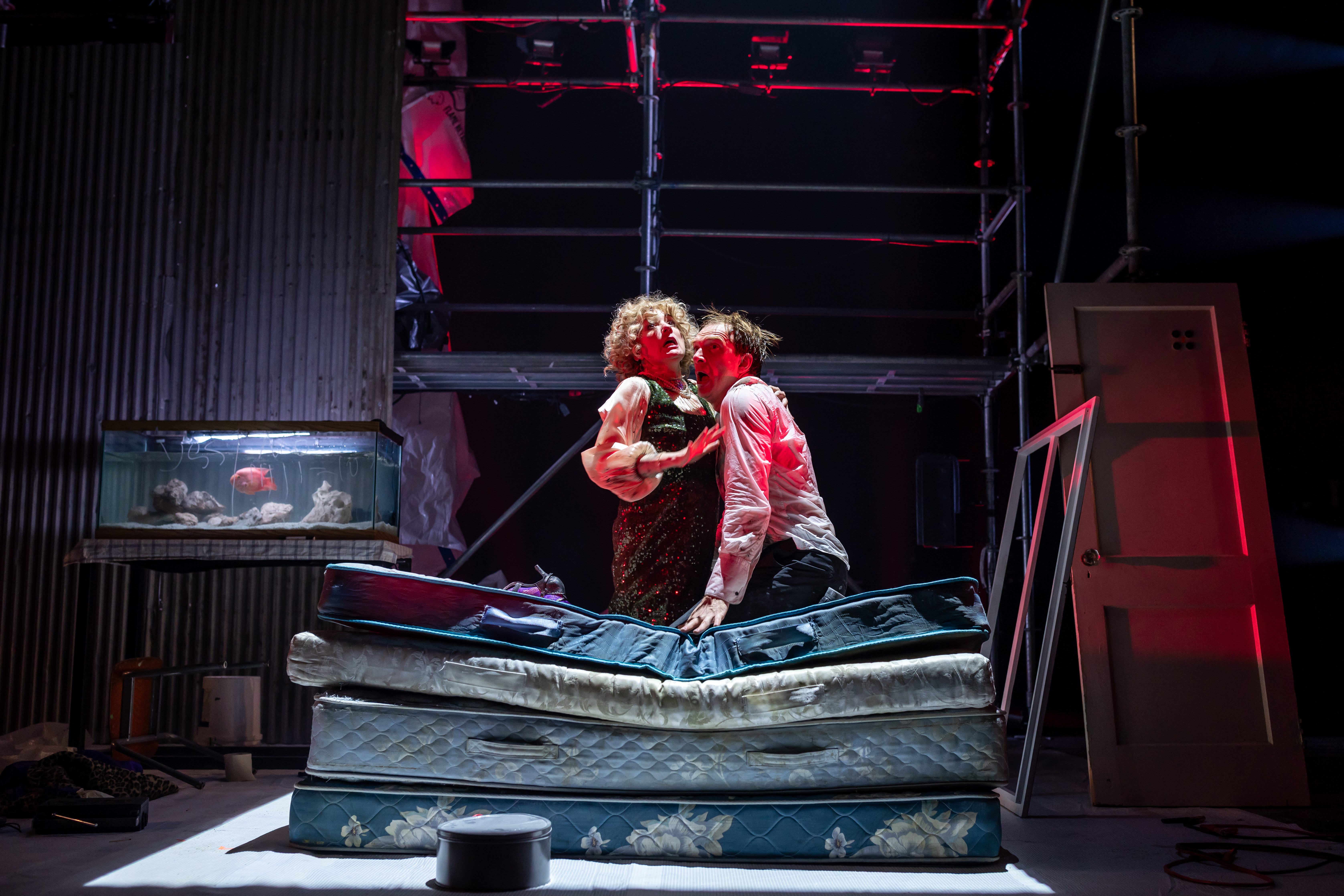
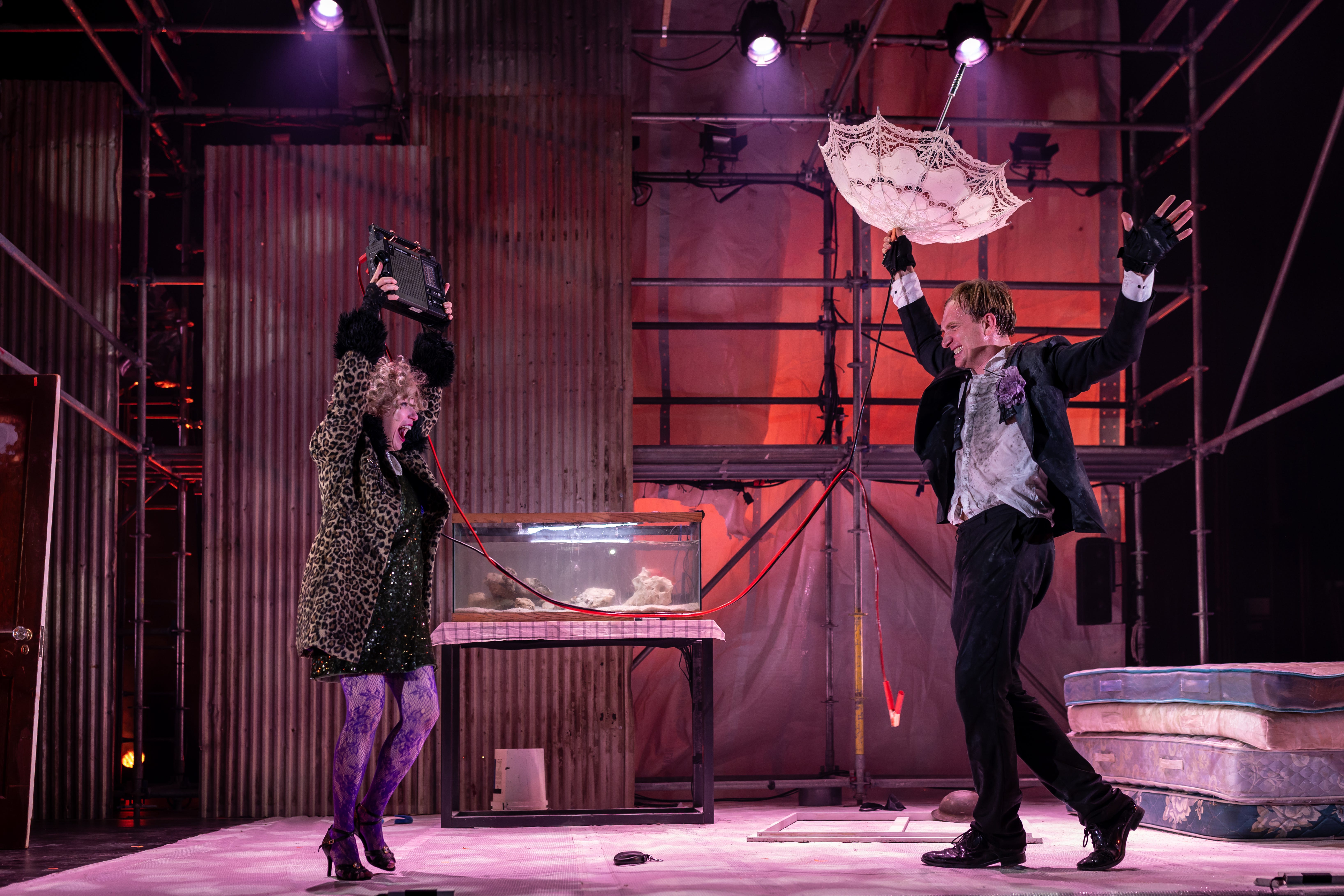
Not a metaphor of a fish. A real fish, alive, in a real tank, on the stage, for the entire play, while the apartment around it is stripped to nothing. The fish was never in the text. It could not be in the text. And it was suddenly the truest thing on the stage.
We named her Jeannette, after a nonsense fairy tale about going to the moon that Ionesco wrote for his daughter, a story I had folded into the adaptation so the couple could leave the aquarium for one moment and fly into their own shared imagination. After we named her we threw her a welcoming party. We got in touch with her agent. The actors started to complain that the fish was stealing their scenes. She has an aquarium and she has an equity contract and she does not know that any of us are here.
The tank stays through the whole piece. By the end she is the only thing on the stage we have not destroyed. When the couple cannot decide something, where Jeannette swims decides it for them. Drift left, the wife wins. Drift right, the husband wins. She has no idea she is deciding anything. She is a live and beautiful thing continuing to be alive in the middle of two people tearing each other apart, the way the fields around Auschwitz keep their calm light. I stood in those fields once, making another play. What stopped my breath was not the horror. It was the trees, still growing, indifferent and alive.
Nature does not know what we have done. The fish does not know she is casting the deciding vote. And neither do we.
None of that is on the page. All of it is the play.
Chulpan Khamatova and Andrei Burkovsky are masters. They were among the best actors in Russia, and they left at the start of the war, and they have carried their homes on their backs ever since, which is exactly what a snail and a turtle do, which is why this play is theirs and belongs to no one else. So I did not hand them the shape. I handed them obstacles. To cross from one side of the room to the other they could never walk in a straight line. There must always be a puddle in the center, something in the way.
Out of the obstacles the invention came pouring. A dog leash becomes the pull-cord of a generator, because in Ukraine right now a generator is not a metaphor, it is the difference between light and dark. Two people invent survival in front of you, in real time, and you watch them make it out of nothing. That visible act is the reimagination. It is not decoration on top of Ionesco. It is the only way Ionesco can breathe now.
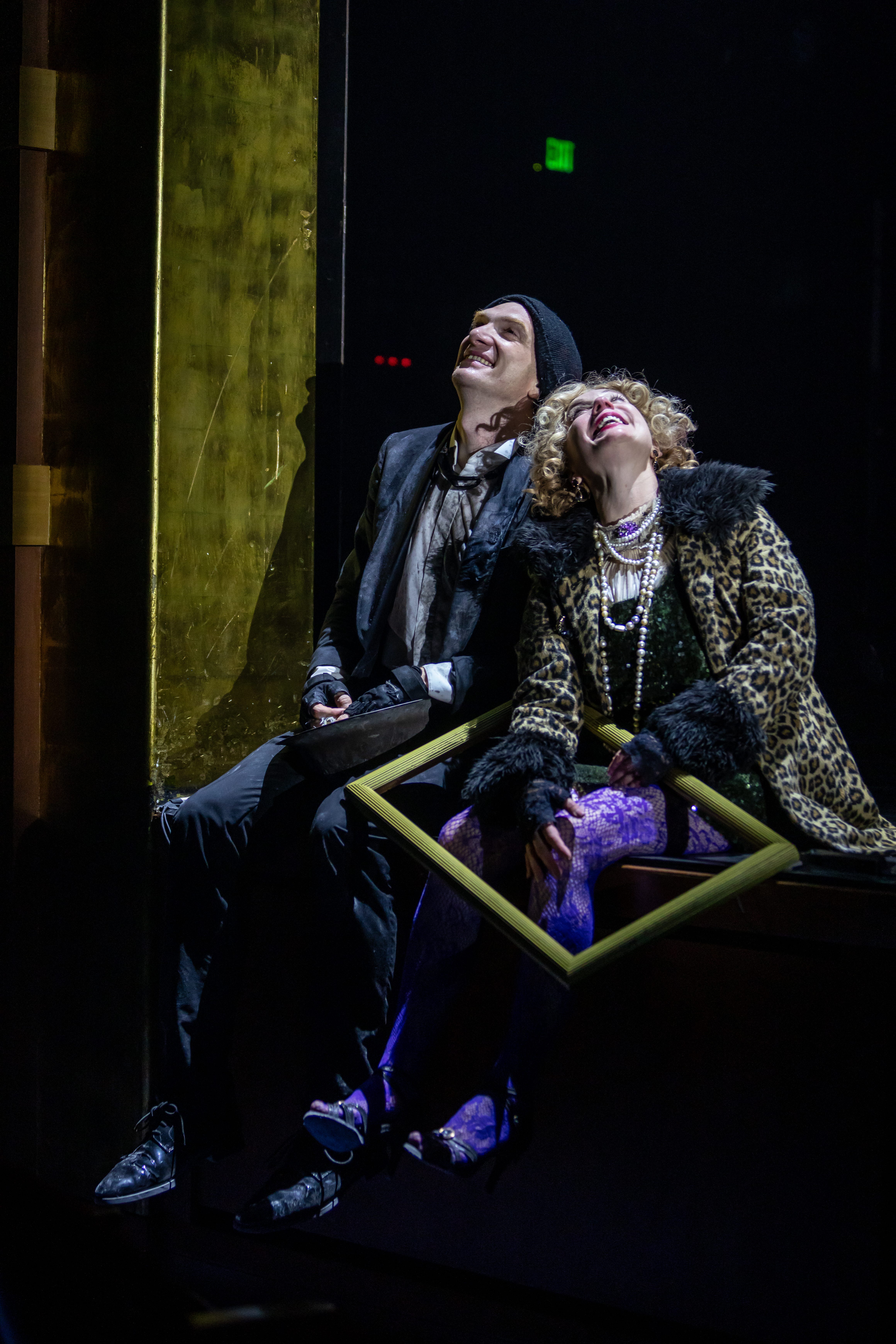
Ionesco put those characters in a bathrobe, a thing that meant something in 1962 and means nothing today. So I do not put an actor in a bathrobe and call it fidelity. I ask what a bathrobe was, a thing you wear when you are not going anywhere, or are preparing to go somewhere, and I dress the couple in the best clothes they put on seventeen years ago to go out on the night the war started, clothes they have never taken off since.
That is more faithful to Ionesco than the bathrobe. It is faithful to the animal, not the shell it crawled out of.
People hear reimagination and assume rewriting. It is the opposite. Nearly every word spoken on my stage is Ionesco’s, including the tales I folded in from his journals. I rebuild the forms and keep the words.
And here is the part the “faithful” director never gets to feel. When you stop serving the text and start building the living thing, the play begins to tell you things the writer never wrote. Someone in the audience said it to me. The fish in her tank, the couple in their sealed room, us in the theater. Three sealed worlds, nothing crossing. I had not thought of it. It was not in my plan and it was not in the script. It was simply there, because we had built something alive enough to have thoughts of its own. A corpse does not surprise you.
Another night a man ran up to me and asked “how did you know.” He had been in a bomb shelter in Israel, and there was a small girl, and to keep her from the fear the grown people began building her a story, each adding a piece. He showed me the photo. A choo-choo train of frightened adults turned into children around one child. That is the scene the couple fall into when they leave the aquarium. I did not know. Ionesco knew. He wrote it for his daughter after his own war, long before ours, and I only dug the living thing out and built it a form.
This is the whole job. Go deeper into the text than the “faithful” director ever goes, deep enough to find what the writer hid there, the way life hides what matters most, then build the form that can hold it now. The test is simple. If what you found makes the writer larger, it was his. If it makes him smaller, it was yours. Ask of every stage direction not how do I do this, but what was he trying to survive when he wrote it. Answer that in your own century, with your own dead, and throw the instruction manual away.
The author gave you the shell. Your job is the animal.
absolutely brilliant and illuminating in so many ways! "it will please the three people in the audience who have studied ionesco, because they are not watching a play, they are recognizing a text, and recognition is its own small love." i appreciate what you do even more than i already do after reading this.
Such beautiful insights from beginning to end! "The words are not there to tell you what is happening. They are there to cover it." Simple and a great reminder. And how great to work with such full-on collaborators. Hope to see this.